Your child is enrolled in preschool. The classroom looks cheerful, the teachers seem kind, and your little one comes home happy. But here's the question that keeps nagging: is this program actually preparing them for kindergarten — or just keeping them busy until pick-up?
It's a fair question, and it's one that more parents should be asking. The word "preschool" covers an enormous range of experiences, from rigorous academic preparation to loosely supervised free play. The difference between those two ends of the spectrum shows up clearly on the first day of kindergarten — and the effects ripple through elementary school and beyond. For college-educated Bay Area parents who value both developmental best practices and genuine academic preparation, understanding what to look for in a preschool curriculum can be the difference between a confident kindergarten transition and a stressful game of catch-up.
TL;DR: Not all preschool programs prepare children equally for kindergarten. The difference between a strong early curriculum and a glorified babysitting arrangement comes down to a few key factors: intentional phonics and literacy instruction, structured math foundations, social-emotional development, and enrichment that builds real skills like coding and bilingualism. Here's a practical framework for evaluating any preschool's curriculum — and what to look for beyond the tour.
Why Curriculum Quality Matters More Than You Think
Research consistently shows that children who enter kindergarten with strong foundational skills in literacy, numeracy, and social-emotional readiness outperform their peers not just in kindergarten — but throughout elementary school. The long-term academic trajectory is often set before a child ever walks into a kindergarten classroom.
But the research also reveals something important: it's not just about attending any preschool. The quality of the curriculum within the program is what drives outcomes. A child who spends two years in a structured, intentional learning environment enters kindergarten in a fundamentally different position than a child who spent those same two years in a program with minimal academic structure.
What does research identify as the key predictors of kindergarten success?
- Phonological awareness — recognizing letter sounds, rhyming, and the building blocks of reading
- Number sense — counting, recognizing numerals, understanding basic quantity concepts
- Ability to follow multi-step directions — a critical classroom skill that many children lack
- Social skills in group settings — sharing, turn-taking, participating in group activities, managing emotions
- Fine motor control — pencil grip, letter formation readiness, cutting, and manipulating small objects
A preschool curriculum that systematically develops all five of these areas is doing the work that matters most. One that focuses on only one or two — or none at all — is leaving gaps your child will have to close later.
The Building Blocks of a Strong Preschool Curriculum
When you're evaluating a preschool program, here are the core components to look for — and what each one actually means for your child's development.
Systematic Phonics and Early Literacy
This is the foundation of reading readiness. A strong program doesn't just read stories aloud (though that matters too). It teaches letter recognition, letter-sound correspondence, phonological awareness, and pre-writing skills through structured, sequential instruction. By the end of a quality preschool program, children should be recognizing most letters and their sounds, and beginning to blend sounds together.
Math Foundations
Early math goes well beyond counting to 10. Look for programs that include number recognition, pattern identification, shape concepts, sorting and classifying, and basic operations. The best programs make math tangible — using manipulatives, games, and real-world objects so that abstract concepts become concrete.
Science and Discovery
Hands-on exploration develops curiosity, observation skills, and early scientific thinking. Programs that include guided experiments, nature exploration, and structured discovery activities build the kind of questioning mindset that serves children across every subject.
Social-Emotional Development
This is the area many parents overlook — but kindergarten teachers will tell you it's one of the most important. Can your child share, take turns, manage frustration, follow group norms, and express their needs verbally? Programs that intentionally teach conflict resolution, emotional regulation, and group participation skills are preparing children for the social demands of kindergarten, not just the academic ones.
Fine and Gross Motor Development
Writing readiness requires fine motor strength and coordination that develop through specific activities: puzzles, art projects, manipulative toys, cutting practice, and guided drawing. Gross motor activities — running, climbing, balancing, throwing — build coordination and physical confidence. Both matter more than many parents realize.
Creative Expression
Art, music, and dramatic play aren't filler. They develop self-expression, imagination, fine motor skills, and the ability to follow multi-step creative processes. Programs that cut these in favor of more worksheets are missing an important piece of whole-child development.
At East Valley Christian Preschool in San Jose's Evergreen area, the Abeka curriculum covers all of these components systematically, with programs structured by developmental stage — Toddler (ages 2–3), Preschool (ages 3–4), and Transitional Kindergarten (ages 4–6) — so that each year builds intentionally on the previous one.
Play-Based vs. Academic — It's Not Either/Or
One of the most persistent myths in early childhood education is that parents must choose between a "play-based" program and an "academic" program. The research tells a different story: the most effective preschool curricula use both.
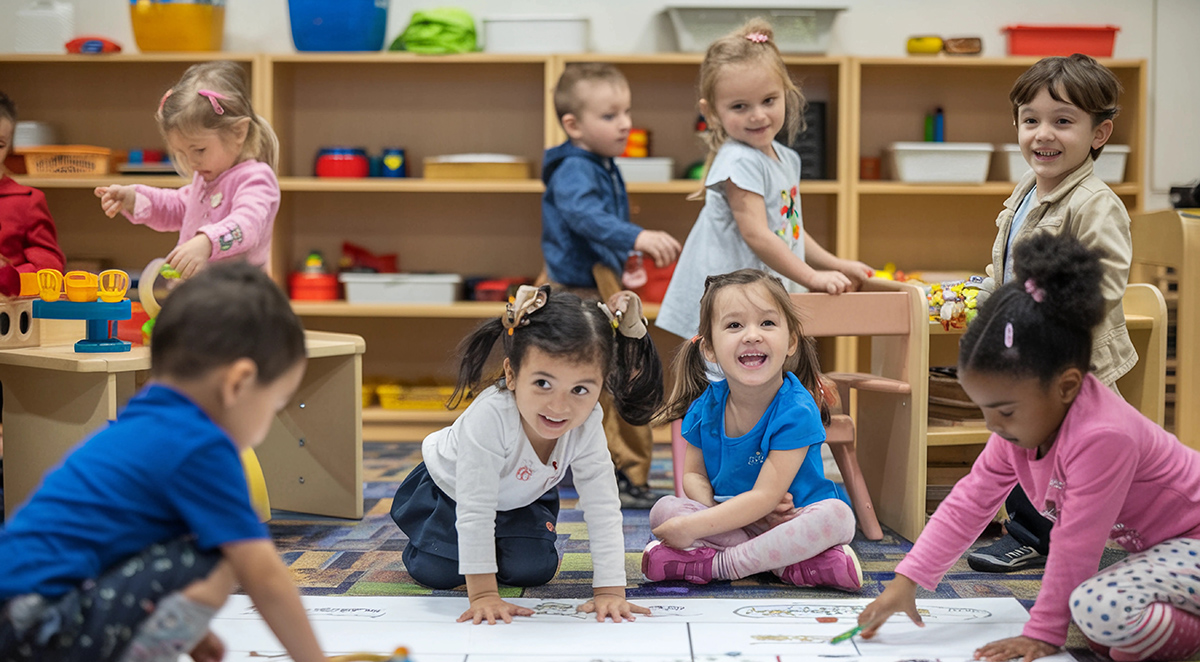
Developmental experts call this approach "purposeful play" or "structured play." It looks playful to the child — they're building, exploring, sorting, creating, and interacting — but it's intentionally designed by the teacher to build specific skills. A block-building activity might be developing spatial reasoning and early engineering concepts. A sorting game might be teaching patterns and classification. A dramatic play scenario might be building vocabulary and social negotiation skills.
The key distinction is between free play with no learning objective and guided play with intentional outcomes. Both have a place in a quality program, but a curriculum built entirely on unstructured free play is unlikely to produce the specific kindergarten readiness skills your child needs.
A well-designed daily schedule balances structured skill development blocks (phonics, math, writing practice) with sensory activities, creative exploration, outdoor play, and enrichment — so children are learning all day without the experience ever feeling like drudgery. That balance is what produces children who are both kindergarten-ready and excited about learning.
Enrichment Programs — The Advantage Most Parents Overlook
When touring preschools, most parents ask about the core curriculum — reading, math, the basics. Fewer think to ask about enrichment programs. But research increasingly shows that early exposure to activities like coding, foreign language, and STEM exploration builds cognitive skills that enhance all other learning.
Here's why these "extras" are actually essentials:
- Coding (screen-free) — Develops sequencing, logic, cause-and-effect reasoning, and persistence. These are the same cognitive skills that support reading comprehension and mathematical thinking. At EVCP, children ages 4–6 learn coding concepts through Space Rover sets — physical building kits, not screens.
- Spanish language — Early bilingual exposure builds phonological awareness (which directly supports English reading skills), cognitive flexibility, working memory, and cultural competency. All preschoolers at EVCP receive Spanish instruction during the optimal window for language acquisition.
- STEM exploration — Hands-on science and engineering activities develop hypothesis testing, observation, and the ability to ask and investigate questions — skills that kindergarten teachers increasingly expect.
When evaluating preschools, ask whether enrichment programs are built into the daily schedule or billed as separate add-ons. Programs that include them in tuition are signaling that they consider them core to the educational experience, not optional upgrades.
Red Flags — Signs a Program May Not Be Preparing Your Child
Not every program that calls itself a preschool is delivering genuine kindergarten preparation. Here are warning signs to watch for:
- No structured daily schedule, or the schedule is vague when you ask to see it
- Heavy reliance on screen time during the day
- Teachers can't articulate specific learning objectives for your child's age group
- No formal curriculum, or the curriculum is entirely teacher-created without a research-backed framework
- Little to no communication with parents about what children are learning week to week
- High staff turnover or teachers without early childhood education credentials
- No assessment or progress tracking of any kind
- "Free play" makes up the majority of every day with no intentional learning structure layered in
Any one of these might have a reasonable explanation. Several of them together are a pattern worth taking seriously.
What Kindergarten-Ready Actually Looks Like
If you want a concrete picture of what your child should be able to do when they walk into kindergarten, here are the benchmarks that matter most:
- Recognize most uppercase and lowercase letters and their sounds
- Count to at least 20 and recognize basic numerals
- Hold a pencil correctly and write their first name
- Follow 2–3 step directions without repeated prompting
- Sit and focus during a group activity for 10–15 minutes
- Take turns, share, and manage basic emotions like frustration and disappointment
- Express needs, ideas, and questions verbally with confidence
- Demonstrate curiosity and willingness to try new things
Children who complete the Transitional Kindergarten program at EVCP typically enter kindergarten with skills that meet or exceed these benchmarks. Many go on to become leaders in their kindergarten classrooms and maintain academic advantages throughout their elementary years — a testament to what a strong early curriculum can produce.
Questions to Ask on Every Preschool Tour
Wherever you're looking, bring this list with you. These questions will tell you more than any brochure:
- What curriculum do you use, and is it research-backed?
- Can I see a written daily schedule for my child's age group?
- What specific academic and developmental skills will my child work on this year?
- How do you assess progress, and how often do you communicate that to parents?
- What enrichment programs are offered — and are they included in tuition or billed separately?
- How long have your teachers been with the program, and what are their qualifications?
- What does the afternoon look like for children in extended care? Is it structured or unstructured?
- Does the school offer continuity beyond preschool (elementary, K–12)?
- What accreditations does the program hold?
- Do you welcome families from all backgrounds?
The answers to these questions — especially the ones about afternoon structure, teacher tenure, and enrichment inclusion — will quickly separate programs that are preparing children from programs that are simply housing them.
Frequently Asked Questions
What's the difference between a preschool curriculum and daycare?
A preschool curriculum is a structured, sequential educational program designed to develop specific academic, social, and developmental skills aligned with kindergarten readiness benchmarks. Daycare primarily provides supervision and care. The easiest way to tell the difference: ask to see a written daily schedule with specific learning objectives, the name of the curriculum being used, and how child progress is assessed and communicated to parents. A program that can't answer those questions clearly is likely closer to childcare than education.
Is play-based learning as effective as structured academics for kindergarten readiness?
The most effective approach combines both. Research supports "purposeful play" — activities that look and feel playful to the child but are intentionally designed by the teacher to build specific skills. A program built entirely on free play without learning objectives is unlikely to produce strong kindergarten readiness outcomes. Similarly, a program that's all worksheets with no hands-on exploration is missing the developmental benefits of play. The best programs balance structured instruction with guided play, creative expression, and physical activity throughout the day.
How early should children start learning phonics and math?
Children can begin developing pre-literacy and pre-numeracy skills as early as age 2 through age-appropriate exposure to letter sounds, counting, patterns, and stories. Formal systematic phonics instruction typically begins around ages 3–4, with increasing structure in the Transitional Kindergarten year (ages 4–5). The key is that instruction should be developmentally appropriate — using hands-on materials, songs, games, and interactive activities rather than worksheets and rote memorization at young ages.
What accreditations should I look for in a preschool?
Look for recognized accreditations that confirm a program meets established educational standards. In California, WASC (Western Association of Schools and Colleges) accreditation is a widely respected mark of academic quality. ACSI (Association of Christian Schools International) accreditation evaluates faith-based programs specifically. Dual accreditation — holding both — indicates a program that has been evaluated rigorously from multiple perspectives. Accreditation matters because it requires ongoing self-evaluation, external review, and a commitment to continuous improvement.
Does it matter if a preschool offers enrichment programs like coding or Spanish?
Yes — more than most parents realize. Early coding activities build sequencing, logic, and problem-solving skills that support academic learning across subjects. Early Spanish exposure enhances phonological awareness (a key predictor of English reading success), builds cognitive flexibility, and takes advantage of the developmental window when language acquisition comes most naturally. Programs that include these enrichments in their core offering are providing measurable cognitive advantages, not just fun activities.
Choosing a Curriculum That Sets Your Child Up
The right preschool curriculum gives your child more than a head start on reading and math. It builds the confidence, social skills, and love of learning that shape their entire relationship with school. The parents who ask the hard questions on tours — about curriculum structure, teacher qualifications, enrichment inclusion, and kindergarten readiness outcomes — are the ones who find programs that deliver on the promise of early education.
If you'd like to see what a kindergarten-ready curriculum looks like in practice, we invite you to schedule a visit at East Valley Christian Preschool in the Evergreen area of San Jose. We enroll year-round, and families of all backgrounds are welcome.